3.4. Calibration
Calibration is the least invasive intervention in this part. It leaves the kind of representation untouched: a first-order distribution goes in, and a first-order distribution comes out. What changes is the scale of the probabilities, that is, the relation between the confidence the model reports and the frequency with which it is correct. A model that is right in 70% of the cases in which it predicts 0.99 is miscalibrated in exactly this sense, however good its accuracy may be.
Modern deep networks have been observed to be systematically overconfident [GPSW17], and calibration addresses this problem directly. Note that it complements the other methods in this part rather than competing with them: the members of an ensemble may each be miscalibrated, and averaging their predictions need not remove the miscalibration.
All methods on this page are post-hoc. The base model is frozen, and a
small number of additional parameters are fitted on a held-out calibration
split via probly.calibrator.calibrate(). Fitting them on the training
split instead is a common mistake: since the model has been fitted to these
data, its predictions look well calibrated there even when they are not.
The methods differ mainly in how much freedom they give the recalibration map, which amounts to the familiar bias-variance trade-off: a more flexible map can fit more complex forms of miscalibration, but needs more calibration data to do so without overfitting. Flexibility has a second price that is easily overlooked. Only temperature scaling is guaranteed to leave the predicted class unchanged; all other methods may change the accuracy of the model, not only its confidence.
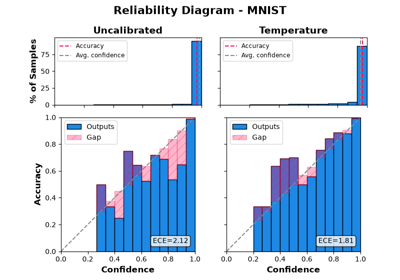
3.4.1. temperature_scaling
Divides the logits by a single learned scalar T before the softmax. A
temperature T > 1 flattens the predicted distribution, and T < 1
sharpens it. Since dividing all logits by the same positive constant cannot
change their order, the predicted class, and hence the accuracy, is provably
unaffected; only the confidence attached to it changes.
- Idea:
Divide the logits by a single learned scalar
Tbefore the softmax.- Representation:
A first-order distribution with an unchanged ranking of classes, and therefore an unchanged accuracy.
- Advantages:
A single parameter leaves essentially nothing to overfit, so a few hundred calibration points typically suffice. Despite its simplicity, it is often hard to improve on in practice, which is why it is the default.
- Disadvantages:
A single scalar corrects the overall sharpness but not a systematic bias, and it is too coarse when the miscalibration differs across classes.
- Reference:
[GPSW17]
3.4.2. platt_scaling
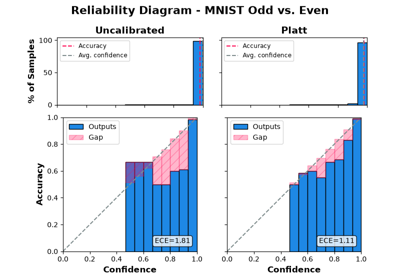
The binary predecessor of temperature scaling fits a logistic regression
sigmoid(a * s + b) that maps the model’s score s to a probability.
Compared with temperature scaling, the intercept b makes it possible to
correct a systematic bias in addition to the sharpness. The same intercept
shifts the decision threshold, however, so the accuracy may change. In
probly, Platt scaling applies to binary classifiers only.
- Idea:
Fit a logistic regression
sigmoid(a * s + b)from the model’s score to a probability.- Representation:
A first-order distribution over two classes, obtained from an uncalibrated score.
- Advantages:
The intercept corrects a systematic bias as well as the sharpness; the natural choice when the base model outputs a score rather than a distribution.
- Disadvantages:
Restricted to binary classification; two parameters can only realize a sigmoid-shaped correction, and the intercept may change the accuracy.
- Reference:
[Pla99]
3.4.3. vector_scaling
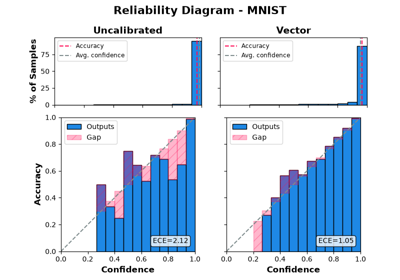
Extends temperature scaling to one temperature and one bias per class, which amounts to a diagonal linear map on the logits. The additional freedom pays off when the miscalibration is not uniform across classes, as is typically the case under class imbalance, where the rare classes tend to be the poorly calibrated ones. Unlike a single temperature, however, per-class parameters can reorder the logits, so vector scaling may change the predicted class.
- Idea:
One temperature and one bias per class, i.e., a diagonal linear map on the logits.
- Representation:
A first-order distribution; the per-class parameters can reorder the logits, so the accuracy may change.
- Advantages:
Handles miscalibration that varies across classes, as it typically arises under class imbalance.
- Disadvantages:
May change the accuracy, and the number of parameters, and with it the amount of calibration data needed, grows with the number of classes.
- Reference:
[GPSW17]

3.4.4. isotonic_regression
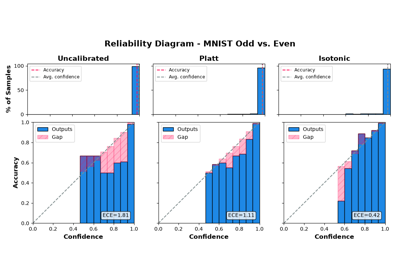
The non-parametric member of the family fits a monotone step function that
maps predicted to observed probabilities. Since it assumes nothing beyond
monotonicity, it can correct any monotone distortion of the probabilities,
including those that a sigmoid, and hence Platt scaling, cannot fit. This
flexibility comes at a price: on a small calibration split, the step function
overfits and produces piecewise-constant probabilities with visible plateaus.
In probly, isotonic regression applies to binary classifiers only.
- Idea:
Fit a monotone step function from predicted to observed probability.
- Representation:
A first-order distribution over two classes. The ranking of inputs by score is preserved up to ties within a plateau, but predictions can move across the decision threshold, so the accuracy may change.
- Advantages:
Non-parametric, so it corrects any monotone miscalibration, including shapes that no sigmoid can fit.
- Disadvantages:
Restricted to binary classification, and overfits on a small calibration split, producing piecewise-constant probabilities with visible plateaus; advisable only when the split is large.
- Reference:
[ZE02]
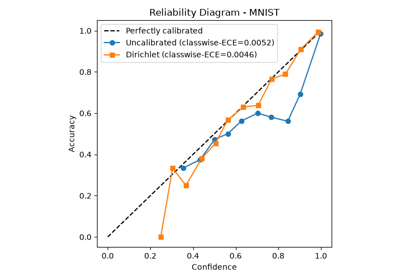
3.4.5. dirichlet_calibration
The most general member of the family fits a full multinomial logistic
regression on the log-probabilities, q = softmax(W ln(p) + b), with a
dense num_classes x num_classes matrix W. It contains temperature
scaling as a special case (and, for two classes, beta calibration), and it
recalibrates log-probabilities rather than logits, which distinguishes it from
matrix and vector scaling. The off-diagonal entries of W let the
calibrated probability of one class depend on the predicted probabilities of
the others, which makes it possible to correct systematic confusions between
classes.
- Idea:
Multinomial logistic regression on the log-probabilities,
q = softmax(W ln(p) + b).- Representation:
A recalibrated first-order distribution; the full map can reorder classes, so the accuracy may change.
- Advantages:
The most general map on this page; contains temperature scaling as a special case and can correct systematic confusions between classes.
- Disadvantages:
Wgrows quadratically in the number of classes, so on many-class problems the off-diagonal and intercept regularizers (reg_lambdaandreg_mu) and additional calibration data become indispensable.- Reference:
3.4.6. Choosing a Method
temperature_scaling is the natural starting point: it has a single parameter, cannot change the accuracy, and typically captures most of the achievable improvement. A more flexible map is worth its additional data requirements only when there is a specific reason to expect a single temperature to fall short. Class imbalance is one such reason and suggests vector_scaling; systematic confusion between particular classes is another and suggests dirichlet_calibration. For binary problems, platt_scaling corrects a bias that temperature scaling cannot, and isotonic_regression is the method of choice when the miscalibration is not sigmoid-shaped and the calibration split is large enough to support a non-parametric fit.
In any case, the result should be assessed with the calibration diagnostics in Evaluating Uncertainty, on data held out from the calibration split as well as from training.
3.4.7. Full API
Create a temperature scaling calibration wrapper based on [GPSW17]. |
|
Create a platt scaling calibration wrapper based on [Pla99]. |
|
Create a vector scaling calibration wrapper based on [GPSW17]. |
|
Create an isotonic regression calibration wrapper based on [ZE02]. |
|
Dirichlet-calibrate a multi-class logit classifier based on [KPerelloNKangsepp+19]. |