Note
Go to the end to download the full example code.
Efficient Credal Prediction on MNIST
Efficient credal prediction turns a single trained classifier into a credal
predictor. After training, it determines for each class the largest additive
offsets of that class’s logit under which the relative likelihood of the
training data stays above a threshold alpha. At inference time, perturbing
the logits by these offsets yields probability intervals, whose width reflects
the epistemic uncertainty of the prediction. The appeal of the method lies in
its cost: only one model is trained, and the bounds are calibrated post hoc
from its training logits.
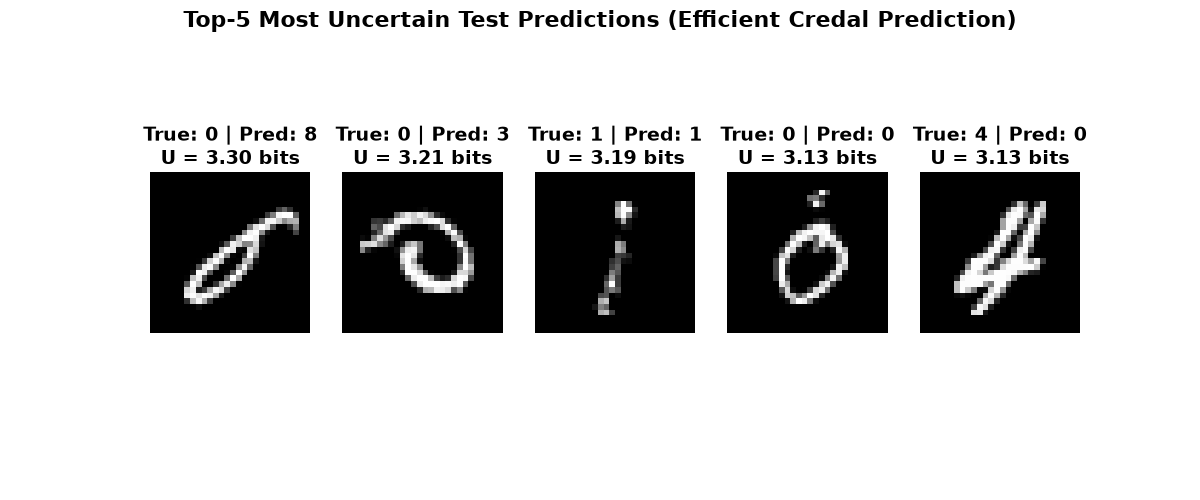
This example applies the method to MNIST and shows the test digits on which the resulting credal predictor is most uncertain.
from __future__ import annotations

import numpy as np
import torch
from torch import nn

from probly.method.efficient_credal_prediction import (
    compute_efficient_credal_prediction_bounds,
    efficient_credal_prediction,
)
from probly.quantification import quantify
from probly.representer import representer
from probly_benchmark.data import load_mnist

from examples.utils.model import MLPClassifier
from examples.utils.plotting import plot_mnist_uncertainty
Setup
Model
base_model = MLPClassifier(in_features=28 * 28, hidden_features=256, out_features=10)
ecp = efficient_credal_prediction(base_model, predictor_type="logit_classifier")
Training
The wrapper leaves the base network unchanged, so the model is trained like any ordinary classifier with the cross-entropy loss.
opt = torch.optim.Adam(ecp.parameters(), lr=1e-3)
ecp.train()
for _epoch in range(5):
    for X_batch, y_batch in train_loader:
        opt.zero_grad()
        loss = nn.functional.cross_entropy(ecp(X_batch.view(-1, 28 * 28)), y_batch)
        loss.backward()
        opt.step()
ecp.eval()
TorchEfficientCredalPredictor(
  (predictor): MLPClassifier(
    (net): Sequential(
      (0): Linear(in_features=784, out_features=256, bias=True)
      (1): ReLU()
      (2): Linear(in_features=256, out_features=256, bias=True)
      (3): ReLU()
      (4): Linear(in_features=256, out_features=10, bias=True)
    )
  )
)
Post-hoc Calibration of the Bounds
The per-class offsets for the threshold alpha are computed from the
logits on the training data and stored on the predictor as lower and
upper.
The choice of alpha requires more care here than in low-dimensional toy
problems. A well-fit MNIST classifier produces large training logits, so
shifting a single class logit changes the training likelihood only slightly,
and a loose threshold consequently admits very large offsets. With
alpha=0.5, for instance, hundreds of test images would receive the
maximal uncertainty of log2(10) bits. A strict threshold such as
alpha=0.99 keeps the credal sets informative.
with torch.no_grad():
    logits_train, targets_train = zip(
        *((ecp(X_batch.view(-1, 28 * 28)), y_batch) for X_batch, y_batch in train_loader)
    )
logits_train = torch.cat(logits_train)
targets_train = torch.cat(targets_train)

lower, upper = compute_efficient_credal_prediction_bounds(
    logits_train, targets_train, num_classes=10, alpha=0.99
)
ecp.lower, ecp.upper = lower.float(), upper.float()
Uncertainty Quantification
The representer turns the base logits and the calibrated offsets into a
credal set per test image. Its uncertainty is quantified with quantify
and converted from nats to bits.
rep = representer(ecp)

with torch.no_grad():
    credal_set = rep.represent(X_test)

uq = quantify(credal_set)
_unc = uq.total if hasattr(uq, "total") else (uq.epistemic if hasattr(uq, "epistemic") else uq.aleatoric)
uncertainty = _unc.detach().numpy() if isinstance(_unc, torch.Tensor) else np.asarray(_unc)
uncertainty = uncertainty / np.log(2)
if uncertainty.ndim > 1:
    uncertainty = uncertainty.sum(axis=-1)
Predictions
Point predictions are the softmax probabilities of the unperturbed base classifier.
with torch.no_grad():
    mean_probs = ecp(X_test).softmax(-1).numpy()

accuracy = (mean_probs.argmax(-1) == y_test.numpy()).mean() * 100
print(f"Test accuracy: {accuracy:.1f}%")
Test accuracy: 97.5%
Visualization
plot = plot_mnist_uncertainty(
    images_test,
    y_test,
    uncertainty,
    mean_probs,
    title="Top-5 Most Uncertain Test Predictions (Efficient Credal Prediction)",
)
plot.show()
Total running time of the script: (0 minutes 34.368 seconds)