Note
Go to the end to download the full example code.
Laplace on MNIST
The Laplace Approximation is a post-hoc method that turns a trained neural network into a Bayesian model by fitting a Gaussian over the last-layer weights. Uncertainty concentrates on inputs far from the training distribution.
from __future__ import annotations

import numpy as np
import torch
from torch import nn

from laplace import Laplace
from probly.quantification import quantify
from probly.representer import representer
from probly_benchmark.data import load_mnist

from examples.utils.model import MLPClassifier
from examples.utils.plotting import plot_mnist_uncertainty
Setup
Model
Train a standard MLP classifier to convergence; the Laplace approximation is applied afterwards as a post-hoc uncertainty wrapper.
base_model = MLPClassifier(in_features=28 * 28, hidden_features=256, out_features=10)
flat_model = nn.Sequential(nn.Flatten(), base_model)

opt = torch.optim.Adam(flat_model.parameters(), lr=1e-3)

flat_model.train()
for _epoch in range(5):
    correct, total = 0, 0
    for X_batch, y_batch in train_loader:
        opt.zero_grad()
        out = flat_model(X_batch)
        loss = nn.functional.cross_entropy(out, y_batch)
        loss.backward()
        opt.step()
        correct += (out.detach().argmax(-1) == y_batch).sum().item()
        total += len(y_batch)
    if correct / total >= 0.97:
        break
Laplace Approximation
Fit a Kronecker-factored (KFAC) Laplace approximation over the last layer of
the trained model. No retraining is needed. The fitted model is picked up by
probly.method.laplace, so the generic representer works on it directly.
flat_model.eval()

laplace_model = Laplace(
    flat_model,
    "classification",
    subset_of_weights="last_layer",
    hessian_structure="kron",
)
laplace_model.fit(train_loader)
Uncertainty Quantification
rep = representer(laplace_model, num_samples=200)

with torch.no_grad():
    representation = rep.represent(X_test)

uq = quantify(representation)
_unc = uq.total if hasattr(uq, "total") else (uq.epistemic if hasattr(uq, "epistemic") else uq.aleatoric)
uncertainty = _unc.detach().numpy() if isinstance(_unc, torch.Tensor) else np.asarray(_unc)
uncertainty = uncertainty / np.log(2)
if uncertainty.ndim > 1:
    uncertainty = uncertainty.sum(axis=-1)
Predictions
with torch.no_grad():
    mean_probs = flat_model(X_test).softmax(-1).numpy()

accuracy = (mean_probs.argmax(-1) == y_test.numpy()).mean() * 100
print(f"Test accuracy: {accuracy:.1f}%")
Test accuracy: 97.3%
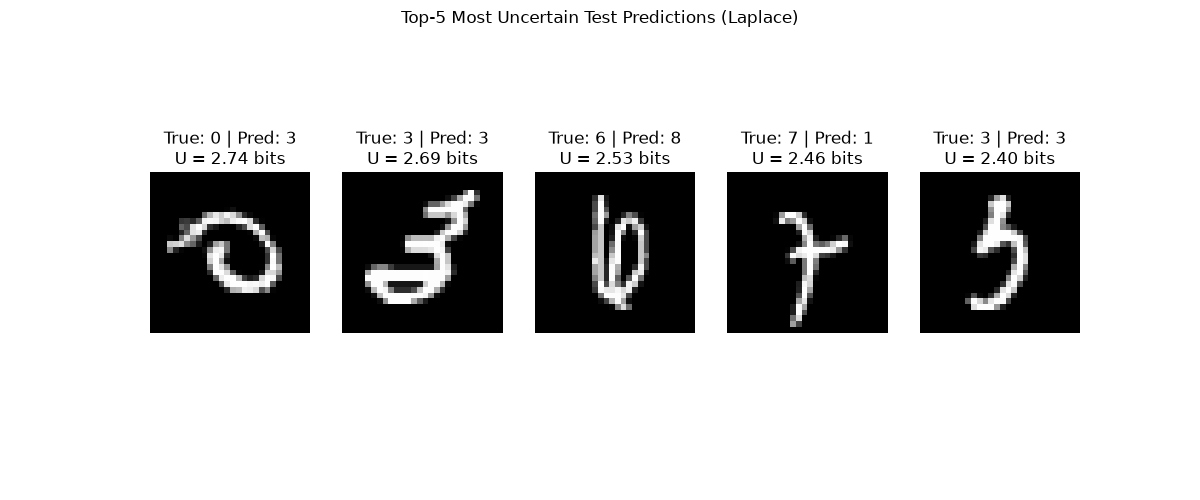
Visualization
plot = plot_mnist_uncertainty(
    images_test,
    y_test,
    uncertainty,
    mean_probs,
    title="Top-5 Most Uncertain Test Predictions (Laplace)",
)
plot.show()
Total running time of the script: (0 minutes 42.376 seconds)