Note
Go to the end to download the full example code.
Bayesian Neural Network on Two Moons
Replace point-estimate weights with distributions and train them with the ELBO loss. Every forward pass samples new weights, so predictions are inherently stochastic.
from __future__ import annotations

from sklearn.datasets import make_moons
import torch

from probly.representer import representer
from probly.transformation import bayesian
from probly.losses.torch import elbo_loss
from probly.transformation.bayesian import collect_kl_divergence

from examples.utils.model import MLPClassifier
from examples.utils.plotting import plot_example_uncertainty
Setup
X, y = make_moons(n_samples=500, noise=0.05, random_state=0)
X_tensor = torch.from_numpy(X).float()
y_tensor = torch.from_numpy(y).long()
Model
base_model = MLPClassifier()

bayesian_model = bayesian(
    base_model,
    use_base_weights=False,  # initialize posterior means randomly rather than from base_model
    posterior_std=0.05,      # initial posterior std; small = near-deterministic start
    prior_mean=0.0,
    prior_std=1.0,           # smaller = stronger regularization toward zero
    predictor_type="logit_classifier",
)
Training
elbo_loss(out, y, kl, kl_penalty=beta) computes: cross_entropy(out, y) + beta * kl. beta = 1/N scales the KL so its magnitude is independent of dataset size. collect_kl_divergence walks the model and sums the KL from every BayesianLinear layer, which must be called after each forward pass because each forward pass draws new weight samples.
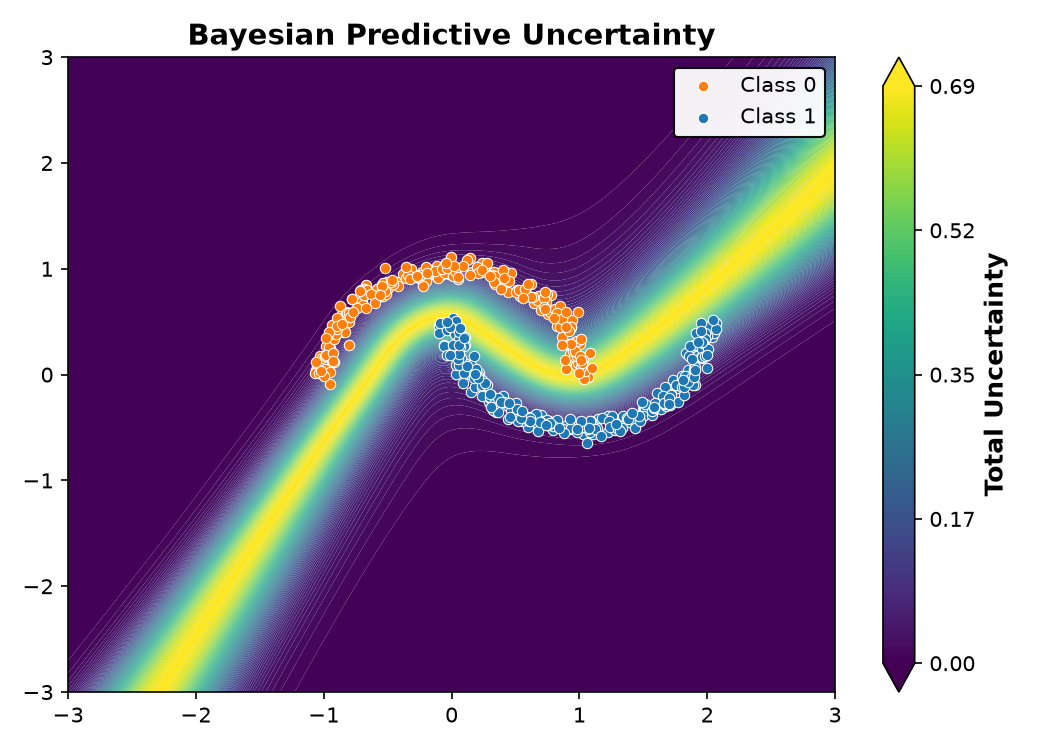
Uncertainty Evaluation
bayesian_model.eval()
rep = representer(bayesian_model, num_samples=200)

plot = plot_example_uncertainty(X, y, rep, title="Bayesian Predictive Uncertainty", notion="total")
plot.show()
Total running time of the script: (0 minutes 5.466 seconds)