Note
Go to the end to download the full example code.
Prior Network on MNIST
A Prior Network parameterizes a Dirichlet distribution over class
probabilities, with concentration parameters alpha = exp(logits), and is
trained with explicit out-of-distribution (OOD) data: in-distribution digits
are pushed towards a sharp Dirichlet on the true class, and OOD inputs towards
a flat one. Here, uniform noise images serve as OOD training data. This is
admittedly the simplest possible choice, and the example is meant to
illustrate the mechanism rather than a realistic OOD detection setup.
from __future__ import annotations

import matplotlib.pyplot as plt
import numpy as np
import torch
from torch import nn
from torch.utils.data import DataLoader, TensorDataset

from probly.losses.torch import pn_loss
from probly.method.prior_network import prior_network
from probly.quantification import quantify
from probly.representer import representer
from probly_benchmark.data import load_mnist

from examples.utils.model import MLPClassifier
from examples.utils.plotting import plot_mnist_uncertainty
Setup
Model
base_model = MLPClassifier(in_features=28 * 28, hidden_features=256, out_features=10)
pn_model = prior_network(base_model, predictor_type="logit_classifier")
Training
pn_loss sums the KL divergences from sharp in-distribution targets and
flat OOD targets to the predicted Dirichlet distributions, and adds a small
cross-entropy term. Each batch of flattened training images is paired with
freshly sampled uniform noise images as OOD inputs. Note that the
in-distribution targets infer the number of classes from the batch labels.
The loader therefore uses drop_last=True, which avoids a small final
batch that might miss a digit.
X_train_batches, y_train_batches = zip(*train_loader)
X_train_flat = torch.cat([x.view(-1, 28 * 28) for x in X_train_batches])
y_train = torch.cat(list(y_train_batches))

flat_dataloader = DataLoader(
    TensorDataset(X_train_flat, y_train),
    batch_size=256,
    shuffle=True,
    drop_last=True,
)

opt = torch.optim.Adam(pn_model.parameters(), lr=1e-3)
grad_clip_norm = 0.5

pn_model.train()
for _epoch in range(5):
    for inputs, targets in flat_dataloader:
        opt.zero_grad()
        x_ood = torch.rand_like(inputs)
        loss = pn_loss(pn_model, inputs, targets, x_ood)
        loss.backward()
        nn.utils.clip_grad_norm_(pn_model.parameters(), grad_clip_norm)
        opt.step()
Uncertainty Quantification
The epistemic uncertainty of each predicted Dirichlet is quantified with
quantify and converted from nats to bits.
pn_model.eval()
rep = representer(pn_model)

with torch.no_grad():
    representation = rep.represent(X_test)

uq = quantify(representation)
uncertainty = uq.epistemic.detach().numpy() / np.log(2)
Predictions
Point predictions are the means of the predicted Dirichlet distributions,
alpha / sum(alpha).
with torch.no_grad():
    alpha = pn_model(X_test)
    mean_probs = (alpha / alpha.sum(dim=-1, keepdim=True)).numpy()

accuracy = (mean_probs.argmax(-1) == y_test.numpy()).mean() * 100
print(f"Test accuracy: {accuracy:.1f}%")
Test accuracy: 98.2%
Visualization
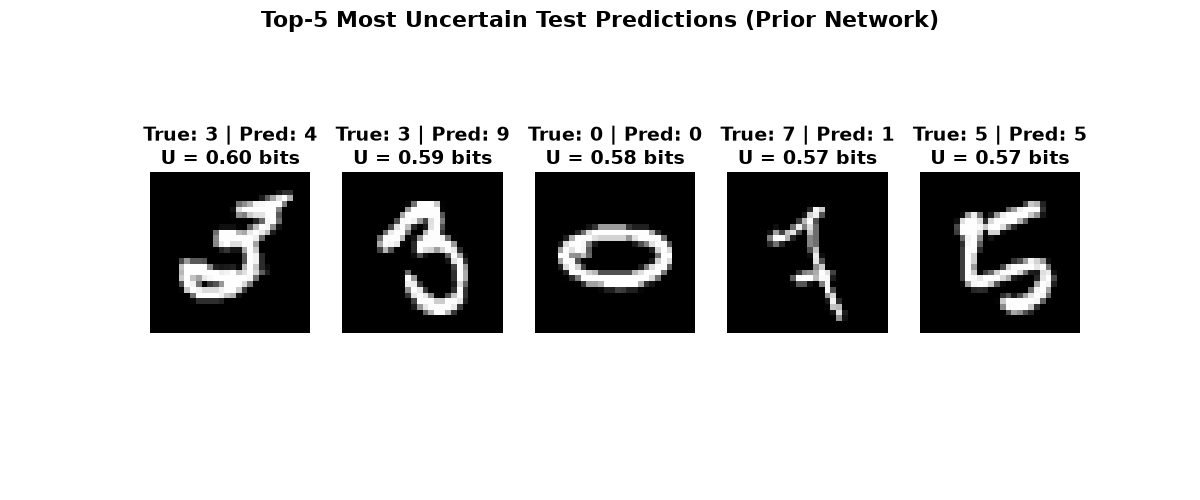
plot = plot_mnist_uncertainty(
    images_test,
    y_test,
    uncertainty,
    mean_probs,
    title="Top-5 Most Uncertain Test Predictions (Prior Network)",
)
plot.show()
In-Distribution vs. OOD
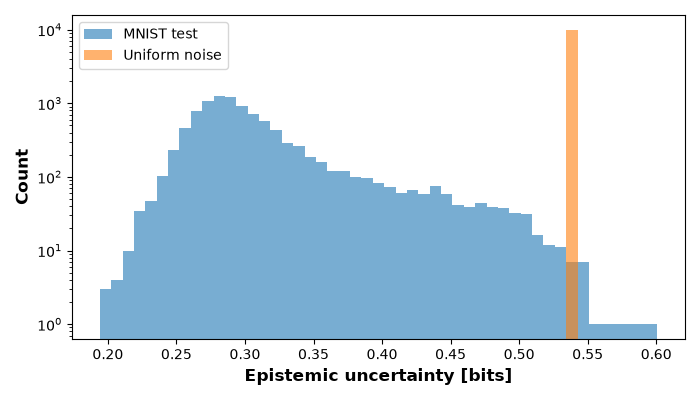
The model was trained to predict a flat Dirichlet on noise, and unseen uniform noise images accordingly receive a much higher epistemic uncertainty than almost all MNIST test digits. Note, however, that these images come from the same distribution as the OOD training data. The histogram therefore shows that the model has learned the separation it was trained for, not that it detects OOD inputs of a different kind.
X_noise = torch.rand(len(X_test), 28 * 28)
with torch.no_grad():
    uncertainty_noise = quantify(rep.represent(X_noise)).epistemic.numpy() / np.log(2)

fig, ax = plt.subplots(figsize=(7, 4))
all_uncertainty = np.concatenate([uncertainty, uncertainty_noise])
bins = np.linspace(all_uncertainty.min(), all_uncertainty.max(), 50)
ax.hist(uncertainty, bins=bins, alpha=0.6, label="MNIST test")
ax.hist(uncertainty_noise, bins=bins, alpha=0.6, label="Uniform noise")
ax.set_xlabel("Epistemic uncertainty [bits]")
ax.set_ylabel("Count")
ax.set_yscale("log")
ax.legend()
fig.tight_layout()
plt.show()
Total running time of the script: (0 minutes 22.414 seconds)