Getting Started
probly turns any PyTorch, Flax/JAX or scikit-learn model into an uncertainty-aware one in a
single line of code, and offers methods, representations and quantification measures in one place,
without committing you to a framework or to a particular view of what uncertainty is.
Machine learning is increasingly deployed in safety-critical settings, where a prediction alone is
not enough: one also wants to know how far it can be trusted. probly makes that quantifiable,
and separates the two sources that matter in practice, aleatoric uncertainty arising from noise in
the data and epistemic uncertainty arising from a lack of knowledge, which can be reduced with more
data or a better model.
To follow the example below, start with the Installation instructions; for the theory behind it and further reading, see Next Steps.
How Probly Works
A model becomes uncertainty-aware in four stages:
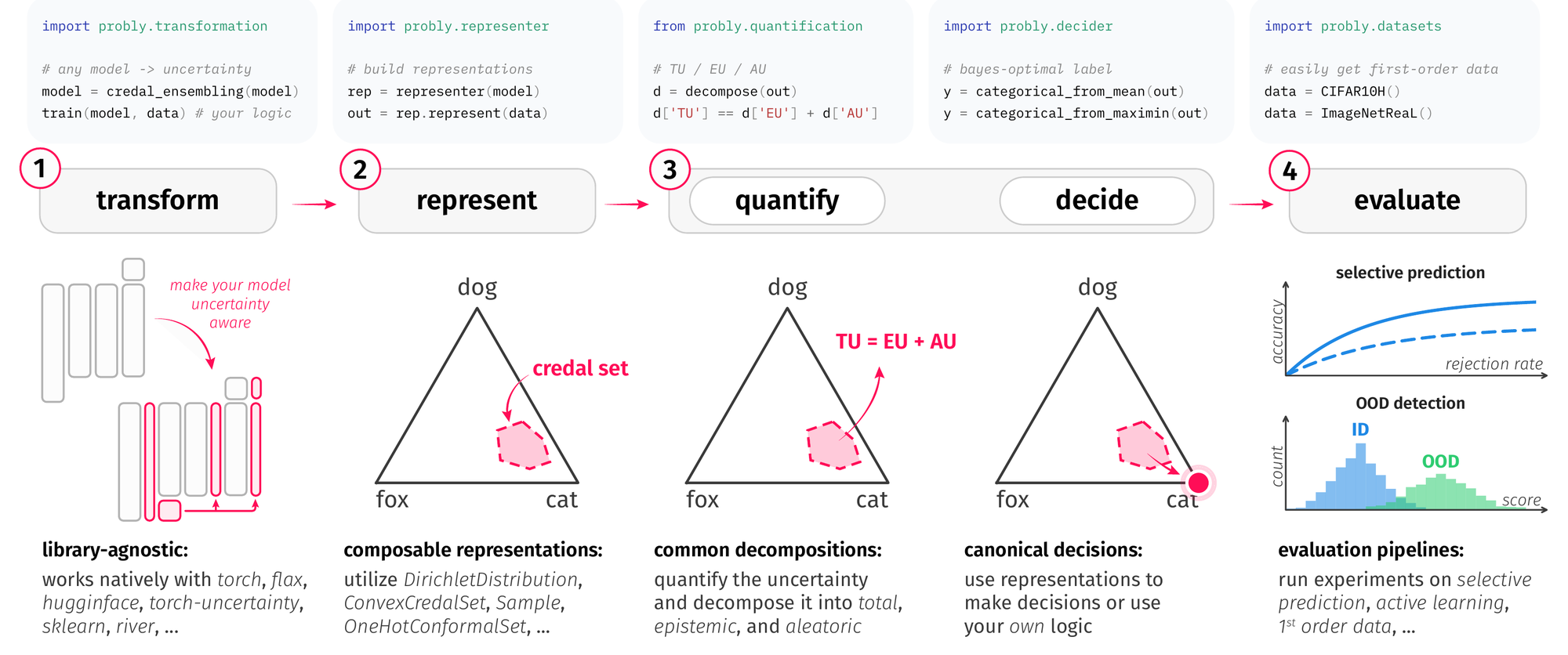
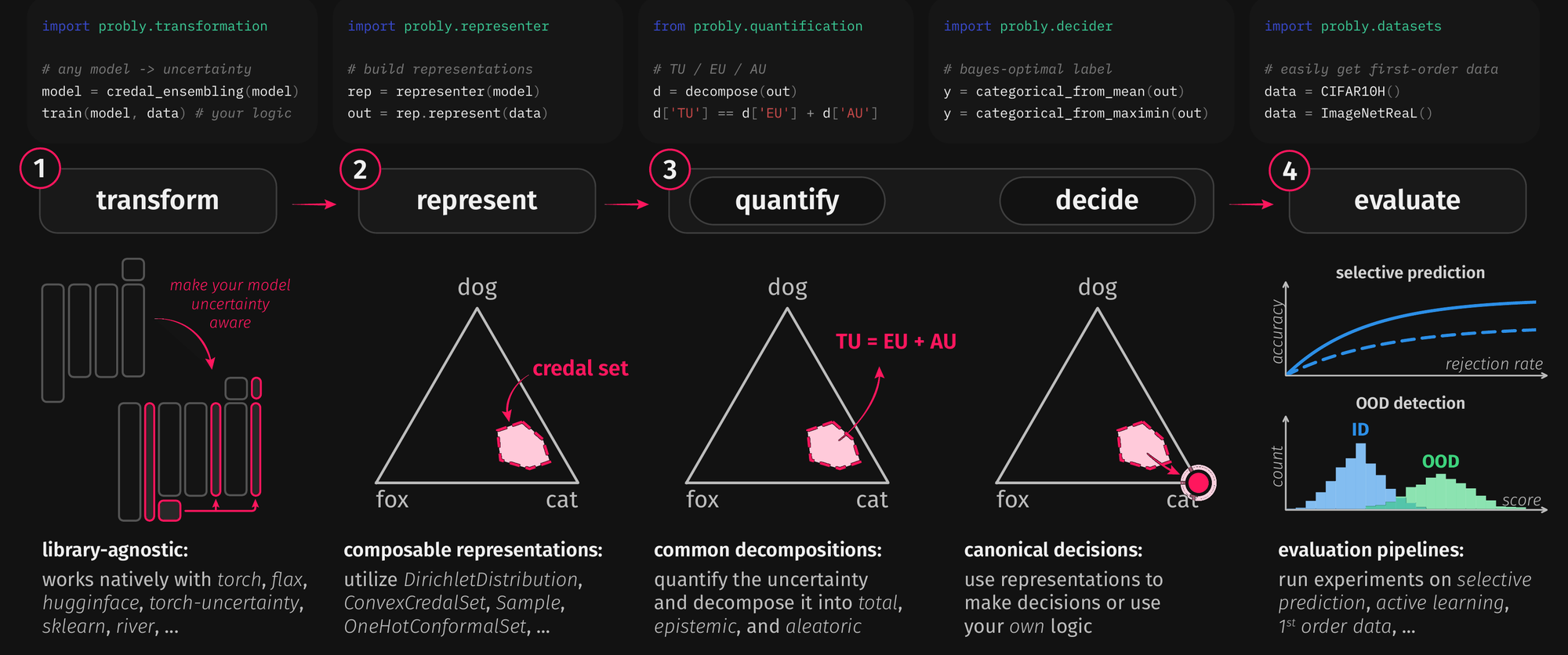
The example follows the probly pipeline and applies it to an exemplary model, in this case the Two-Moons Dataset, and applies
the dropout method to make it uncertainty aware.
To make your model uncertainty aware, using a method like dropout you need the following imports:
import torch
from torch import nn
from sklearn.datasets import make_moons

from probly.method import dropout                            # choose your preferred method
from probly.representer import representer                   # either use the default representer or chose a custom matching one
from probly.quantification import quantify
from probly.evaluation.selective_prediction import selective_prediction  # if you want to evaluate the data, use the given evaluation
For an overview on methods and representer check out the respective chapters in the user-guide.
As well as your model to transform, we are defining a simple Classifier as follows:
class MLPClassifier(nn.Module):
    def __init__(
        self, in_features: int = 2, hidden_features: int = 64, out_features: int = 2
    ) -> None:
        super().__init__()
        self.net = nn.Sequential(
            nn.Linear(in_features, hidden_features),
            nn.ReLU(),
            nn.Linear(hidden_features, hidden_features),
            nn.ReLU(),
            nn.Linear(hidden_features, out_features),
        )

    def forward(self, x: torch.Tensor) -> torch.Tensor:
        return self.net(x)
To use the two-moons dataset using PyTorch, we must prepare it as follows:
X, y = make_moons(n_samples=500, noise=0.05, random_state=0)
X_tensor = torch.from_numpy(X).float()
y_tensor = torch.from_numpy(y).long()
Now we can begin the probly pipeline:
1. Transformation
The first step is choosing any of the methods to transform the model into an uncertainty aware one.
Instead of changing the model however, it wraps it as a Predictor and therefore does not change
the underlying model. This step allows the measuring of uncertainty as well as the splitting into
Aleatoric and Epistemic Uncertainty.
For this example we use dropout:
base_model = MLPClassifier()

dropout_model = dropout(
    base_model,
    p=0.5,
    predictor_type="logit_classifier",
    shared_mask=True,
)
Depending on the method you might need to adapt the parameters or proceed with the default option. The User Guide or alternatively the API Reference offer information about all the transformations.
Train the wrapped model just like you would train the original one, dropout stays active at inference time, which is what enables repeated forward passes to produce a distribution over predictions:
opt = torch.optim.Adam(dropout_model.parameters(), lr=1e-3)

dropout_model.train()
for _ in range(300):
    opt.zero_grad()
    loss = nn.functional.cross_entropy(dropout_model(X_tensor), y_tensor)
    loss.backward()
    opt.step()

dropout_model.eval();
2. Representation
Having the correct Representation is key for later measuring and evaluating the uncertainty. probly offers
both first and second order distributions as well as credal sets. To choose the representation either select
the generic representer or any of the more targeted representers in probly.representer
(see Pillar 2: Representation).
rep = representer(dropout_model, num_samples=100)
representation = rep.represent(X_tensor)
3. Quantification
To understand and decide on a model’s robustness, there needs to be a metric. Quantification delivers such a measure
either as an actual measure or a decomposition depending on the transformation. This choice is decided downstream through the
quantify method:
quantification = quantify(representation)
uncertainty = quantification.total.detach().numpy()
if uncertainty.ndim > 1:
    uncertainty = uncertainty.sum(axis=-1)
4. Evaluation
Finally probly offers a unified evaluation structure. Here we perform selective prediction: sorting instances
by their uncertainty and checking whether the most uncertain ones are indeed the ones the model gets wrong.
with torch.no_grad():
    predictions = dropout_model(X_tensor).argmax(-1)
losses = (predictions != y_tensor).float().numpy()

aurc, bin_losses = selective_prediction(uncertainty, losses)
print(f"AURC: {aurc:.4f}")
AURC: 0.0061
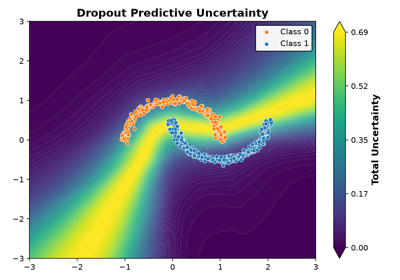
Plotting allows easy understanding of uncertainty, a variation of the dropout example can be seen here:
Next Steps
Many steps happen downstream behind the curtain, allowing easy application of probly!
However to get a deeper understanding of probly, its workings and how to use it for your own applications, check out
our User Guide.
For the exhaustive overview of methods check out API Reference and for a practical insight look at Examples and Tutorials. Found a method that is missing please refer to our guide Adding a New Method.
Finally have fun using probly!