NumpyProbabilityIntervalsCredalSet
- class probly.representation.credal_set.numpy.NumpyProbabilityIntervalsCredalSet(lower_bounds: ndarray, upper_bounds: ndarray)[source]
Bases:
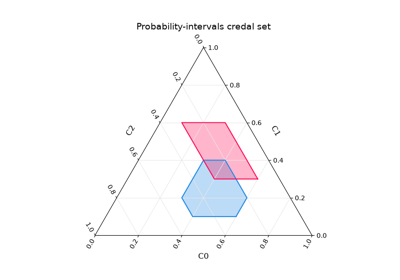
NumpyAxisProtected[NumpyProbabilityIntervalsCredalSet,NumpyProbabilityIntervalsCredalSet,NumpyProbabilityIntervalsCredalSet,Never,NumpyProbabilityIntervalsCredalSet,NDArray[bool],NumpyProbabilityIntervalsCredalSet],NumpyCategoricalCredalSet,ProbabilityIntervalsCredalSetCredal set represented by lower/upper categorical bounds.
- property T: ShapeResultT
The transposed version of the underlying array.
- astype(dtype: DTypeLike, order: Order = 'K', casting: Literal['no', 'equiv', 'safe', 'same_kind', 'unsafe'] = 'unsafe', subok: bool = True, copy: bool = True) OpResultT[source]
Cast each protected field using ndarray.astype’s casting and layout options.
- property barycenter: NumpyCategoricalDistribution
Compute the barycenter of the credal set as the center of the probability intervals.
- contains(probabilities: ndarray) ndarray[source]
Check whether probabilities are inside the intervals.
- property flags: ArrayFlagsLike
The flags of the array.
- classmethod from_numpy_sample(sample: NumpySample[NumpyCategoricalDistribution]) Self[source]
Create a credal set from categorical distribution samples.
- classmethod from_sample(sample: Sample[NumpyCategoricalDistribution]) Self[source]
Create a credal set from a sample of categorical distributions.
- lower_bounds: np.ndarray
- property mT: ShapeResultT
The transposed version of the underlying array.
- permitted_functions = {}
- permitted_ufuncs = {}
- primary_protected_name = 'lower_bounds'
- protected_axes = {'lower_bounds': 1, 'upper_bounds': 1}
- protected_values(func: Callable | None = None, method: str | None = None) dict[str, NumpyProtectedValue] | None[source]
Read effective values, with optional NumPy function or ufunc permissions.
- reshape(*shape: int | tuple[int, ...], order: str = 'C', copy: bool | None = None) ShapeResultT[source]
Return a copy with reshaped protected values.
- property shape: tuple[int, ...]
Read the logical shape without collecting fields unless all broadcast.
- transpose(*axes: int | Sequence[int] | None) ShapeResultT[source]
Return a transposed version of the NumpySample.
This method implicitly also provides full axis tracking support for - np.moveaxis - np.rollaxis Those functions call out to transpose methods for custom array types.
- Parameters:
axes – The axes to transpose.
- Returns:
A transposed version of the NumpySample.
- type = 'categorical'
- upper_bounds: np.ndarray