Note
Go to the end to download the full example code.
Evidential Regression on a 1D Example
Deep evidential regression obtains uncertainty estimates from a single
deterministic network. Roughly speaking, instead of predicting a Gaussian
directly, the network predicts a distribution over the parameters of that
Gaussian. More specifically, the last linear layer of a regressor is replaced
by a head that outputs the parameters (gamma, nu, alpha, beta) of a
Normal-Inverse-Gamma (NIG) distribution, which serves as a prior over the mean
mu and variance sigma^2 of a Gaussian likelihood. A single forward
pass therefore yields both a prediction and its uncertainty.
Following Amini et al. (2020), the NIG parameters give
the prediction
E[mu] = gamma,the aleatoric uncertainty
E[sigma^2] = beta / (alpha - 1),the epistemic uncertainty
Var[mu] = beta / (nu * (alpha - 1)).
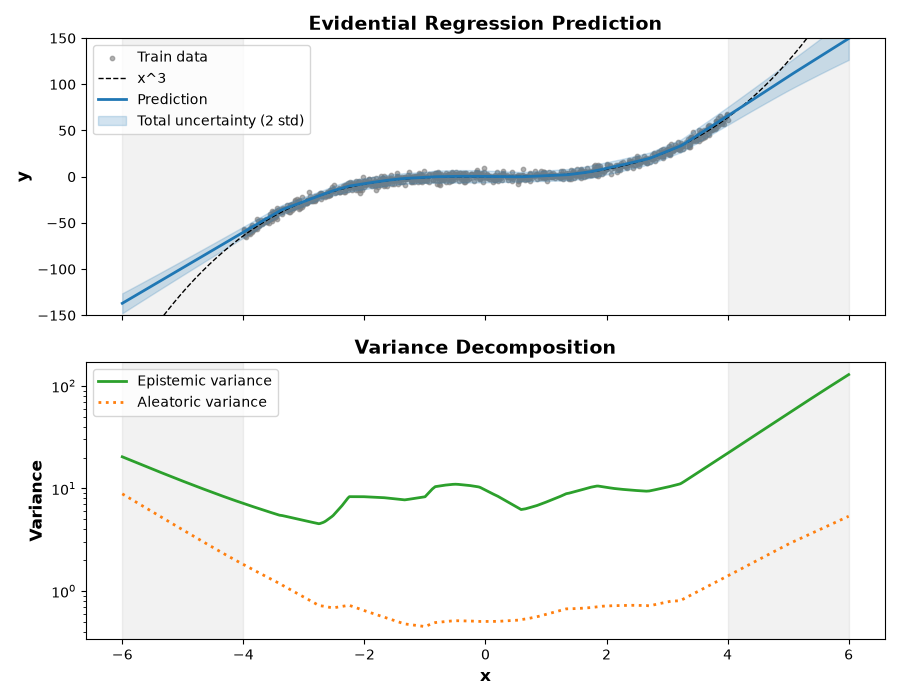
As in the original paper, the model is trained on a noisy cubic function and evaluated on a wider interval, which shows how the uncertainty estimates behave outside the training data.
from __future__ import annotations

import matplotlib.pyplot as plt
import numpy as np
import torch
from torch import nn

from probly.losses.torch import evidential_nignll_loss, evidential_regression_regularization
from probly.method.evidential import evidential_regression
Setup
The targets are y = x^3 + eps with eps ~ N(0, 3^2). The training
inputs cover [-4, 4]; the evaluation grid spans [-6, 6].
x_train_np = np.random.uniform(-4, 4, (1000, 1)).astype(np.float32)
y_train_np = (x_train_np**3 + np.random.normal(0, 3, x_train_np.shape)).astype(np.float32)

X_train = torch.from_numpy(x_train_np)
y_train = torch.from_numpy(y_train_np)
X_grid = torch.linspace(-6, 6, 500).reshape(-1, 1)
Model
The base model is an ordinary MLP regressor. evidential_regression
replaces its final nn.Linear with a Normal-Inverse-Gamma layer, whose
output is a dict with the keys "gamma", "nu", "alpha", and
"beta".
class MLPRegressor(nn.Module):
    def __init__(self) -> None:
        super().__init__()
        self.net = nn.Sequential(
            nn.Linear(1, 100),
            nn.ReLU(),
            nn.Linear(100, 100),
            nn.ReLU(),
            nn.Linear(100, 1),
        )

    def forward(self, x: torch.Tensor) -> torch.Tensor:
        return self.net(x)


model = evidential_regression(MLPRegressor())
Training
The loss is the NIG negative log-likelihood plus a regularizer that penalizes evidence on points with large errors. The regularizer thus discourages the model from being confident where its prediction is wrong. Training proceeds on random minibatches of 128 points.
opt = torch.optim.Adam(model.parameters(), lr=5e-3)
lam = 0.01

model.train()
for _step in range(2000):
    idx = torch.randint(0, len(X_train), (128,))
    opt.zero_grad()
    out = model(X_train[idx])
    loss = evidential_nignll_loss(out, y_train[idx]) + lam * evidential_regression_regularization(out, y_train[idx])
    loss.backward()
    opt.step()
Uncertainty Estimates
The aleatoric and epistemic variances follow from the NIG parameters on the evaluation grid via the formulas above.
model.eval()
with torch.no_grad():
    out = model(X_grid)

gamma = out["gamma"].squeeze(-1).numpy()
nu = out["nu"].squeeze(-1).numpy()
alpha = out["alpha"].squeeze(-1).numpy()
beta = out["beta"].squeeze(-1).numpy()

aleatoric = beta / (alpha - 1)
epistemic = beta / (nu * (alpha - 1))
total_std = np.sqrt(aleatoric + epistemic)
Visualization
The top panel shows the prediction together with a band of two standard deviations of the total uncertainty; the bottom panel separates the aleatoric from the epistemic variance. Outside the training range, where the model has seen no evidence, the epistemic variance grows.
This decomposition should, however, be read with care. The predictive
distribution of the NIG model is a Student-t distribution whose variance is
the sum of the two terms, and the likelihood does not constrain how this
sum is split between them. The network may therefore shift variance from
one term to the other. In this example, the aleatoric part stays well below
the true noise variance of 9, and the growth of the epistemic part
outside the data depends on the initialization rather than being guaranteed
by the method.
x_plot = X_grid.squeeze(-1).numpy()

fig, (ax_pred, ax_unc) = plt.subplots(2, 1, figsize=(9, 7), sharex=True)

for ax in (ax_pred, ax_unc):
    ax.axvspan(-6, -4, color="gray", alpha=0.1)
    ax.axvspan(4, 6, color="gray", alpha=0.1)

ax_pred.scatter(x_train_np.ravel(), y_train_np.ravel(), s=10, color="gray", alpha=0.6, label="Train data")
ax_pred.plot(x_plot, x_plot**3, color="black", linestyle="--", linewidth=1, label="x^3")
ax_pred.plot(x_plot, gamma, color="tab:blue", linewidth=2, label="Prediction")
ax_pred.fill_between(
    x_plot,
    gamma - 2 * total_std,
    gamma + 2 * total_std,
    color="tab:blue",
    alpha=0.2,
    label="Total uncertainty (2 std)",
)
ax_pred.set_ylim(-150, 150)
ax_pred.set_ylabel("y")
ax_pred.legend(loc="upper left")
ax_pred.set_title("Evidential Regression Prediction")

ax_unc.plot(x_plot, epistemic, color="tab:green", linewidth=2, label="Epistemic variance")
ax_unc.plot(x_plot, aleatoric, color="tab:orange", linewidth=2, linestyle=":", label="Aleatoric variance")
ax_unc.set_yscale("log")
ax_unc.set_xlabel("x")
ax_unc.set_ylabel("Variance")
ax_unc.legend(loc="upper left")
ax_unc.set_title("Variance Decomposition")

fig.tight_layout()
plt.show()
findfont: Failed to find font weight 600 for DejaVu Sans, now using 700.
findfont: Failed to find font weight 300 for DejaVu Sans, now using 400.
findfont: Failed to find font weight 300 for STIXGeneral, now using 400.
findfont: Failed to find font weight 300 for STIXGeneral, now using 400.
findfont: Failed to find font weight 300 for STIXNonUnicode, now using 400.
findfont: Failed to find font weight 300 for STIXNonUnicode, now using 400.
findfont: Failed to find font weight 300 for STIXSizeOneSym, now using 400.
findfont: Failed to find font weight 300 for STIXSizeTwoSym, now using 400.
findfont: Failed to find font weight 300 for STIXSizeThreeSym, now using 400.
findfont: Failed to find font weight 300 for STIXSizeFourSym, now using 400.
findfont: Failed to find font weight 300 for STIXSizeFiveSym, now using 400.
findfont: Failed to find font weight 300 for cmmi10, now using 400.
findfont: Failed to find font weight 300 for cmsy10, now using 400.
findfont: Failed to find font weight 300 for cmr10, now using 400.
findfont: Failed to find font weight 300 for cmtt10, now using 400.
findfont: Failed to find font weight 300 for cmti10, now using 400.
findfont: Failed to find font weight 300 for cmb10, now using 400.
findfont: Failed to find font weight 300 for cmss10, now using 400.
findfont: Failed to find font weight 300 for cmex10, now using 400.
findfont: Failed to find font weight 300 for DejaVu Sans, now using 400.
findfont: Failed to find font weight 300 for DejaVu Sans, now using 400.
findfont: Failed to find font weight 300 for DejaVu Sans Mono, now using 400.
findfont: Failed to find font weight 300 for DejaVu Sans Display, now using 400.
Total running time of the script: (0 minutes 5.218 seconds)