Note
Go to the end to download the full example code.
Bayesian Ensemble on MNIST
A BNN replaces point-weight values with distributions; a Bayesian Ensemble trains several BNNs independently with the ELBO loss. Predictions combine within-model uncertainty (weight sampling) and between-model uncertainty (initialization).
from __future__ import annotations

import numpy as np
import torch

from probly.quantification import quantify
from probly.representer import representer
from probly.transformation import bayesian_ensemble
from probly.train.bayesian.torch import ELBOLoss, collect_kl_divergence
from probly_benchmark.data import load_mnist

from examples.utils.model import MLPClassifier
from examples.utils.plotting import plot_mnist_uncertainty
Setup
train_loader, test_loader = load_mnist(batch_size=256)

X_test_batches, y_test_batches = zip(*test_loader)
X_test = torch.cat([x.view(-1, 28 * 28) for x in X_test_batches])
y_test = torch.cat(list(y_test_batches))
images_test = (X_test.view(-1, 28, 28) * 255).byte()

N_train = len(train_loader.dataset)
Model
base_model = MLPClassifier(in_features=28 * 28, hidden_features=256, out_features=10)

bayesian_ensemble_model = bayesian_ensemble(
    base_model,
    num_members=3,
    use_base_weights=False,  # each member initializes its posterior mean independently
    posterior_std=0.05,      # initial posterior std; small = near-deterministic start
    prior_mean=0.0,
    prior_std=1.0,           # smaller = stronger regularization toward zero
    predictor_type="logit_classifier",
)
Training
Train each member independently with the ELBO loss. collect_kl_divergence is called on each member because the KL is accumulated per-member during the forward pass.
criterion = ELBOLoss(1.0 / N_train)

for member in bayesian_ensemble_model:
    member.train()
    opt = torch.optim.Adam(member.parameters(), lr=1e-3)
    for _epoch in range(5):
        correct, total = 0, 0
        for X_batch, y_batch in train_loader:
            opt.zero_grad()
            out = member(X_batch.view(-1, 28 * 28))
            kl = collect_kl_divergence(member)
            loss = criterion(out, y_batch, kl)
            loss.backward()
            opt.step()
            correct += (out.detach().argmax(-1) == y_batch).sum().item()
            total += len(y_batch)
        if correct / total >= 0.97:
            break
Uncertainty Quantification
for member in bayesian_ensemble_model:
    member.eval()
rep = representer(bayesian_ensemble_model)

with torch.no_grad():
    representation = rep.represent(X_test)

uq = quantify(representation)
_total = uq.total
uncertainty = (
    _total.detach().numpy() if isinstance(_total, torch.Tensor) else np.asarray(_total)
)
uncertainty = uncertainty / np.log(2)
if uncertainty.ndim > 1:
    uncertainty = uncertainty.sum(axis=-1)
Predictions
Two-level Monte Carlo: each member averages num_mc Bayesian weight samples
to get its own predictive mean; the ensemble mean is taken across those.
num_mc = 10
with torch.no_grad():
    member_probs = torch.stack([
        torch.stack([m(X_test).softmax(-1) for _ in range(num_mc)]).mean(0)
        for m in bayesian_ensemble_model
    ]).numpy()  # (num_members, N, 10)
mean_probs = member_probs.mean(0)

accuracy = (mean_probs.argmax(-1) == y_test.numpy()).mean() * 100
print(f"Test accuracy: {accuracy:.1f}%")
Test accuracy: 97.1%
Visualization
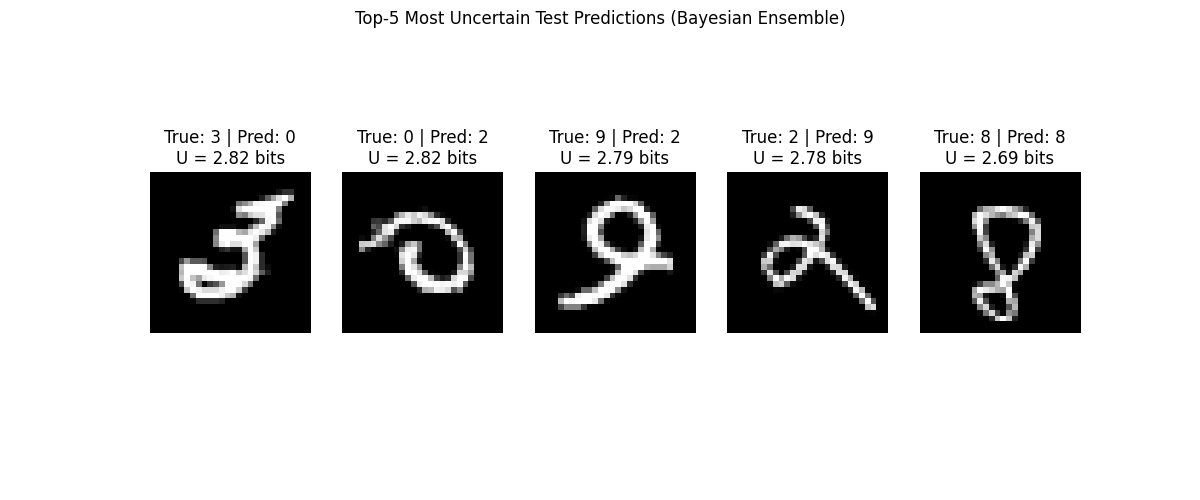
Plot the five most uncertain test digits with per-member agreement.
plot = plot_mnist_uncertainty(
    images_test,
    y_test,
    uncertainty,
    mean_probs,
    title="Top-5 Most Uncertain Test Predictions (Bayesian Ensemble)",
)
plot.show()
Total running time of the script: (1 minutes 20.410 seconds)