Note
Go to the end to download the full example code.
Credal Net on MNIST
Credal Net applies interval arithmetic through the network layers to propagate weight uncertainty forward from inputs to predictions. The resulting credal set represents the range of possible class probabilities consistent with the model’s imprecision, producing probability intervals for each class.
from __future__ import annotations

import numpy as np
import torch
from torch import nn

from probly.method.credal_net import credal_net
from probly.predictor import predict_raw
from probly.quantification import quantify
from probly.representer import representer
from probly.train.credal.torch import intersection_probability_ce_loss
from probly.utils.torch import intersection_probability
from probly_benchmark.data import load_mnist

from examples.utils.model import MLPClassifier
from examples.utils.plotting import plot_mnist_uncertainty
Setup
train_loader, test_loader = load_mnist(batch_size=256)

X_test_batches, y_test_batches = zip(*test_loader)
X_test = torch.cat([x.view(-1, 28 * 28) for x in X_test_batches])
y_test = torch.cat(list(y_test_batches))
images_test = (X_test.view(-1, 28, 28) * 255).byte()
Model
Wrap a base classifier with credal_net so each weight becomes a learnable
interval; use_base_weights=True initializes the interval centers from the
(untrained) base weights.
base_model = MLPClassifier(in_features=28 * 28, hidden_features=256, out_features=10)
prob_model = nn.Sequential(base_model, nn.Softmax(dim=1))
credal_model = credal_net(
    prob_model,
    predictor_type="probabilistic_classifier",
    use_base_weights=True,
)
Training
Train the wrapped credal net directly with the intersection-probability
cross-entropy loss (Eq. 14 of [WCM+24]), which operates on
the packed (lower, upper) interval output produced by predict_raw.
opt = torch.optim.Adam(credal_model.parameters(), lr=1e-3)

credal_model.train()
for _epoch in range(5):
    for X_batch, y_batch in train_loader:
        X_flat = X_batch.view(-1, 28 * 28)
        opt.zero_grad()
        output = predict_raw(credal_model, X_flat)
        loss = intersection_probability_ce_loss(output, y_batch)
        loss.backward()
        opt.step()
credal_model.eval()
Sequential(
  (0): MLPClassifier(
    (net): Sequential(
      (0): IntLinear(in_features=784, out_features=256, bias=True)
      (1): ReLU()
      (2): IntLinear(in_features=256, out_features=256, bias=True)
      (3): ReLU()
      (4_0): IntLinear(in_features=256, out_features=10, bias=True)
      (4_1): IntBatchNorm1d(num_features=10, eps=1e-05, momentum=0.1, affine=True, track_running_stats=True)
      (4_2): IntSoftmax()
    )
  )
)
Uncertainty Quantification
rep = representer(credal_model)

with torch.no_grad():
    credal_set = rep.represent(X_test)

uq = quantify(credal_set)
_unc = uq.total if hasattr(uq, "total") else (uq.epistemic if hasattr(uq, "epistemic") else uq.aleatoric)
uncertainty = _unc.detach().numpy() if isinstance(_unc, torch.Tensor) else np.asarray(_unc)
uncertainty = uncertainty / np.log(2)
if uncertainty.ndim > 1:
    uncertainty = uncertainty.sum(axis=-1)
Predictions
The point prediction is the intersection probability of the learned
(lower, upper) class-probability interval.
with torch.no_grad():
    raw = predict_raw(credal_model, X_test)
    n_classes = raw.shape[-1] // 2
    mean_probs = intersection_probability(raw[..., :n_classes], raw[..., n_classes:]).numpy()

accuracy = (mean_probs.argmax(-1) == y_test.numpy()).mean() * 100
print(f"Test accuracy: {accuracy:.1f}%")
Test accuracy: 98.3%
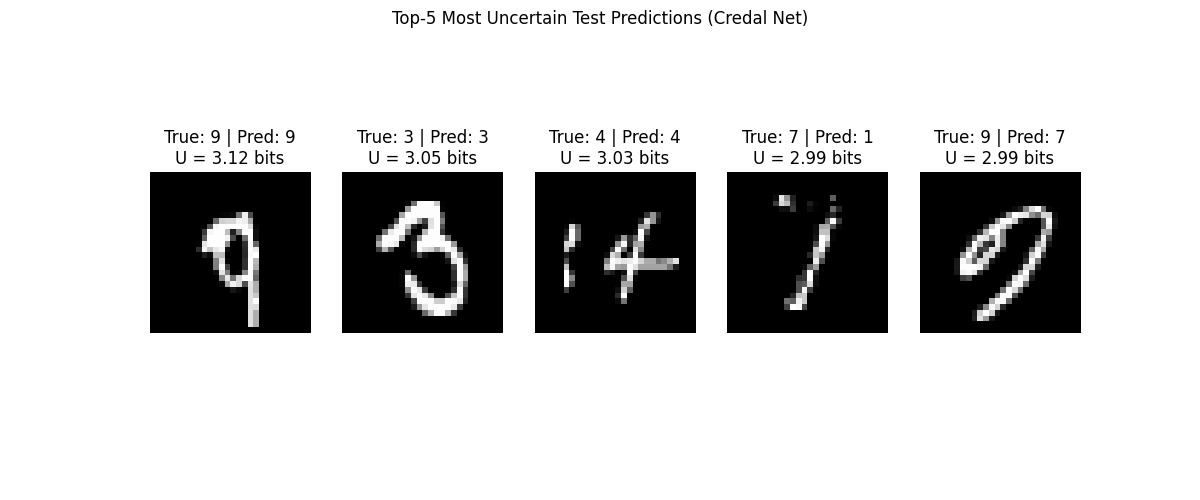
Visualization
plot = plot_mnist_uncertainty(
    images_test,
    y_test,
    uncertainty,
    mean_probs,
    title="Top-5 Most Uncertain Test Predictions (Credal Net)",
)
plot.show()
Total running time of the script: (0 minutes 35.872 seconds)