Note
Go to the end to download the full example code.
Laplace Approximation on Two Moons
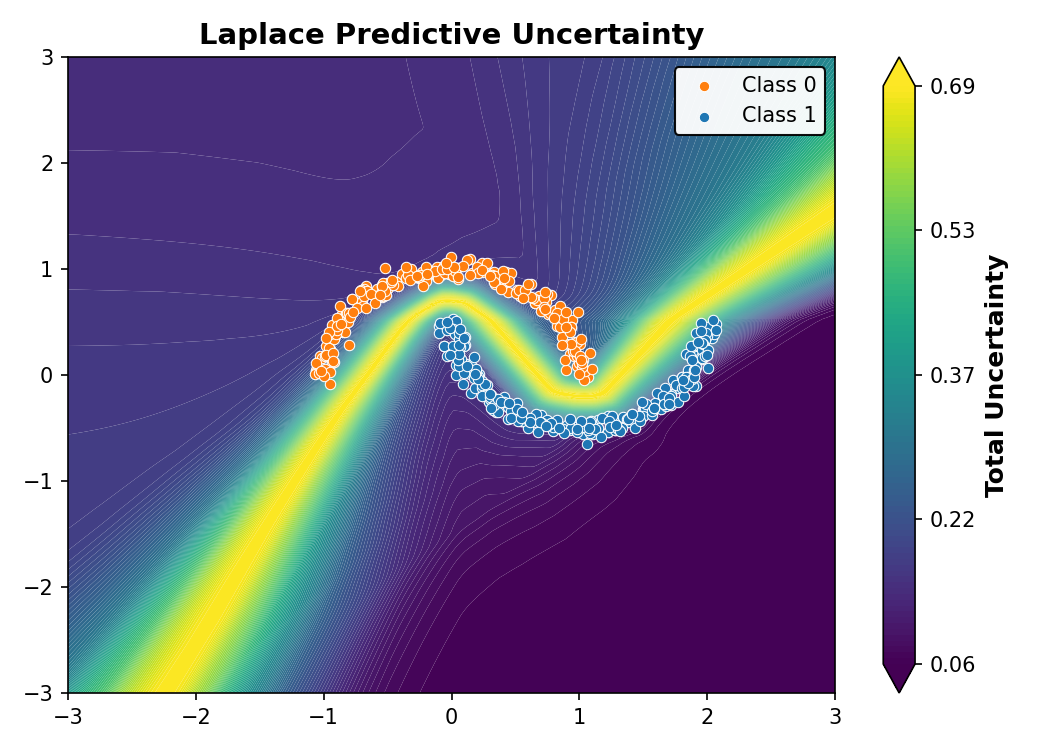
The Laplace Approximation is a post-hoc method that turns a deterministically trained neural network into a Bayesian Neural Network by approximating the posterior over weights with a Gaussian. Uncertainty concentrates along the decision boundary and grows away from the training manifold.
from __future__ import annotations

from laplace import Laplace
from sklearn.datasets import make_moons
import torch
from torch import nn
from torch.utils.data import DataLoader, TensorDataset

from probly.representer import representer

from examples.utils.model import MLPClassifier
from examples.utils.plotting import plot_example_uncertainty
Setup
X, y = make_moons(n_samples=500, noise=0.05, random_state=0)
X_tensor = torch.from_numpy(X).float()
y_tensor = torch.from_numpy(y).long()

dataset = TensorDataset(X_tensor, y_tensor)
train_loader = DataLoader(dataset, batch_size=32, shuffle=True)
Model
Train a standard MLP classifier with mini-batched cross-entropy; the Laplace approximation is applied afterwards as a post-hoc uncertainty wrapper.
base_model = MLPClassifier()

opt = torch.optim.Adam(base_model.parameters(), lr=1e-3)

base_model.train()
for _epoch in range(300):
    for X_batch, y_batch in train_loader:
        opt.zero_grad()
        out = base_model(X_batch)
        loss = nn.functional.cross_entropy(out, y_batch)
        loss.backward()
        opt.step()
Laplace Approximation
Fit a Kronecker-factored (KFAC) Laplace approximation over the last layer of the trained model. No retraining is needed.
base_model.eval()

fit_loader = DataLoader(dataset, batch_size=32)
laplace_model = Laplace(
    base_model,
    "classification",
    subset_of_weights="last_layer",
    hessian_structure="kron",
)
laplace_model.fit(fit_loader)
Uncertainty Evaluation
Total running time of the script: (0 minutes 5.105 seconds)