Note
Go to the end to download the full example code.
Credal Relative Likelihood on MNIST
Credal Relative Likelihood builds an ensemble of perturbed classifiers whose weight perturbations are bounded by a relative likelihood ratio. The resulting probability intervals represent the set of posteriors that are plausible given the training evidence, quantifying epistemic uncertainty via set width.
from __future__ import annotations

import numpy as np
import torch
from torch import nn

from probly.method.credal_relative_likelihood import credal_relative_likelihood
from probly.quantification import quantify
from probly.representer import representer
from probly_benchmark.data import load_mnist

from examples.utils.model import MLPClassifier
from examples.utils.plotting import plot_mnist_uncertainty
Setup
train_loader, test_loader = load_mnist(batch_size=256)

X_test_batches, y_test_batches = zip(*test_loader)
X_test = torch.cat([x.view(-1, 28 * 28) for x in X_test_batches])
y_test = torch.cat(list(y_test_batches))
images_test = (X_test.view(-1, 28, 28) * 255).byte()
Model
base_model = MLPClassifier(in_features=28 * 28, hidden_features=256, out_features=10)
num_members = 5
credal_model = credal_relative_likelihood(
    base_model,
    predictor_type="logit_classifier",
    num_members=num_members,
)
members = list(credal_model)


def _train_one_epoch(member: torch.nn.Module, lr: float) -> None:
    member.train()
    opt = torch.optim.Adam(member.parameters(), lr=lr)
    for X_batch, y_batch in train_loader:
        X_flat = X_batch.view(-1, 28 * 28)
        opt.zero_grad()
        loss = nn.functional.cross_entropy(member(X_flat), y_batch)
        loss.backward()
        opt.step()


@torch.no_grad()
def _log_likelihood(member: torch.nn.Module) -> float:
    member.eval()
    total, count = 0.0, 0
    for X_batch, y_batch in train_loader:
        log_probs = nn.functional.log_softmax(member(X_batch.view(-1, 28 * 28)), dim=-1)
        total += log_probs.gather(1, y_batch.unsqueeze(1)).sum().item()
        count += y_batch.numel()
    return total / count
Training
The first member is trained to convergence on the full data; each subsequent member is trained only until its relative likelihood reaches a per-member threshold, mirroring the benchmark training recipe.
for _epoch in range(5):
    _train_one_epoch(members[0], lr=1e-3)
max_ll = _log_likelihood(members[0])

alpha = 0.5
thresholds = torch.linspace(alpha, 1.0, num_members)[:-1].tolist()

for member, threshold in zip(members[1:], thresholds, strict=True):
    for _epoch in range(5):
        _train_one_epoch(member, lr=1e-3)
        rel_lik = float(np.exp(_log_likelihood(member) - max_ll))
        if rel_lik >= threshold:
            break

for member in members:
    member.eval()
Uncertainty Quantification
rep = representer(credal_model)

with torch.no_grad():
    credal_set = rep.represent(X_test)

uq = quantify(credal_set)
_unc = uq.total if hasattr(uq, "total") else (uq.epistemic if hasattr(uq, "epistemic") else uq.aleatoric)
uncertainty = _unc.detach().numpy() if isinstance(_unc, torch.Tensor) else np.asarray(_unc)
uncertainty = uncertainty / np.log(2)
if uncertainty.ndim > 1:
    uncertainty = uncertainty.sum(axis=-1)
Predictions
with torch.no_grad():
    member_probs = torch.stack([
        member(X_test).softmax(-1) for member in credal_model
    ]).numpy()
mean_probs = member_probs.mean(0)

accuracy = (mean_probs.argmax(-1) == y_test.numpy()).mean() * 100
print(f"Test accuracy: {accuracy:.1f}%")
Test accuracy: 96.3%
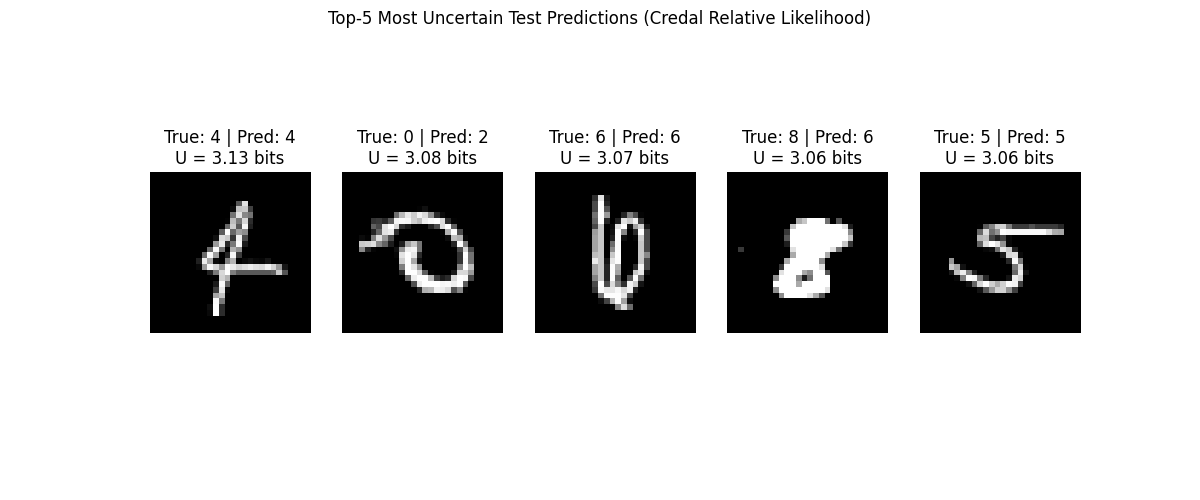
Visualization
plot = plot_mnist_uncertainty(
    images_test,
    y_test,
    uncertainty,
    mean_probs,
    title="Top-5 Most Uncertain Test Predictions (Credal Relative Likelihood)",
)
plot.show()
Total running time of the script: (1 minutes 59.803 seconds)