Note
Go to the end to download the full example code.
MC-Dropout uncertainty on a 2-D stream
A tiny PyTorch MLP trained one sample at a time on a 2-D classification
stream. Wrapping the network with dropout()
makes dropout layers active during inference, so a single
representer() + quantify()
call gives an MC-Dropout uncertainty decomposition on every step.
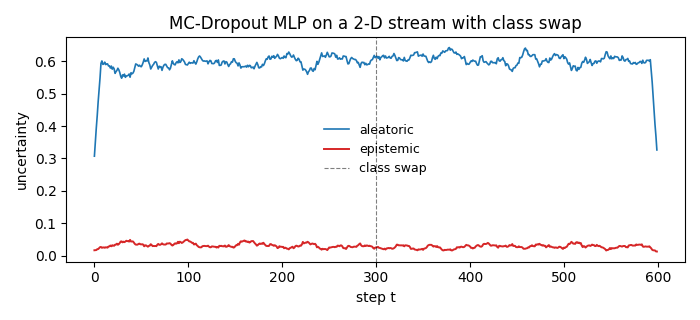
Halfway through the run we swap the class means of the data distribution. Epistemic uncertainty rises immediately after the swap because the network’s stochastic forward passes start to disagree on the unfamiliar inputs.
from __future__ import annotations

import matplotlib.pyplot as plt
import numpy as np
import torch
from torch import nn

from probly.method.dropout import dropout
from probly.quantification import quantify
from probly.representation.distribution.torch_categorical import (
    TorchCategoricalDistribution,
    TorchProbabilityCategoricalDistribution,
)
from probly.representer import representer

torch.manual_seed(0)
rng = np.random.default_rng(0)
Define a tiny network that returns a categorical distribution.
class TinyNet(nn.Module):
    """Two-layer MLP for binary classification."""

    def __init__(self) -> None:
        super().__init__()
        self.net = nn.Sequential(
            nn.Linear(2, 16),
            nn.ReLU(),
            nn.Dropout(0.3),
            nn.Linear(16, 2),
        )

    def forward(self, x: torch.Tensor) -> TorchCategoricalDistribution:
        return TorchProbabilityCategoricalDistribution(torch.softmax(self.net(x), dim=-1))


base = TinyNet()
mc_model = dropout(base, p=0.3)
opt = torch.optim.Adam(base.parameters(), lr=5e-2)
Build a 2-D classification stream that swaps its class means at t = 300.
N_STEPS = 600
DRIFT_T = 300


def stream_step(t: int) -> tuple[np.ndarray, int]:
    """Return one sample, with class means swapped after ``DRIFT_T``."""
    cls = int(rng.integers(0, 2))
    if t < DRIFT_T:
        mu = np.array([0.0, 0.0]) if cls == 0 else np.array([2.0, 2.0])
    else:
        mu = np.array([2.0, 2.0]) if cls == 0 else np.array([0.0, 0.0])
    return rng.normal(mu, 0.5).astype(np.float32), cls
Test-then-train loop. representer(mc_model, num_samples=10) runs
10 stochastic forward passes per step.
epi = np.zeros(N_STEPS)
alea = np.zeros(N_STEPS)
sampler = representer(mc_model, num_samples=10)

for t in range(N_STEPS):
    x_np, y = stream_step(t)
    x = torch.from_numpy(x_np).unsqueeze(0)

    with torch.no_grad():
        decomp = quantify(sampler.represent(x))
    epi[t] = float(decomp.epistemic)
    alea[t] = float(decomp.aleatoric)

    base.train()
    logits = base.net(x)
    loss = nn.functional.cross_entropy(logits, torch.tensor([y]))
    opt.zero_grad()
    loss.backward()
    opt.step()
Plot epistemic and aleatoric uncertainty over time.
window = 15
kernel = np.ones(window) / window
epi_s = np.convolve(epi, kernel, mode="same")
alea_s = np.convolve(alea, kernel, mode="same")

fig, ax = plt.subplots(figsize=(7, 3.2))
ax.plot(alea_s, label="aleatoric", color="#1f77b4", lw=1.2)
ax.plot(epi_s, label="epistemic", color="#d62728", lw=1.4)
ax.axvline(DRIFT_T, color="black", ls="--", lw=0.8, alpha=0.5, label="class swap")
ax.set_xlabel("step t")
ax.set_ylabel("uncertainty")
ax.set_title("MC-Dropout MLP on a 2-D stream with class swap")
ax.legend(frameon=False, fontsize=9)
fig.tight_layout()
plt.show()
Total running time of the script: (0 minutes 7.924 seconds)