Note
Go to the end to download the full example code.
Regression Conformal Prediction — PyTorch
Demonstrate absolute_error_score()
using a small Module on the Diabetes dataset.
After applying conformal_absolute_error()
and calibrating, representer() expands the scalar prediction into
[pred - q, pred + q].
from __future__ import annotations

import matplotlib.pyplot as plt
import numpy as np
import torch
from torch import nn
from sklearn.datasets import load_diabetes
from sklearn.model_selection import KFold, train_test_split

from probly.calibrator import calibrate
from probly.evaluation import coverage, efficiency
from probly.method.conformal import conformal_absolute_error
from probly.representer import representer

torch.manual_seed(42)
<torch._C.Generator object at 0x7fe0a7f90170>
Data preparation
X, y = load_diabetes(return_X_y=True)
X_train, X_test, y_train, y_test = train_test_split(X, y, test_size=0.2, random_state=42)
X_train, X_calib, y_train, y_calib = train_test_split(X_train, y_train, test_size=0.25, random_state=42)

X_train_t = torch.tensor(X_train, dtype=torch.float32)
y_train_t = torch.tensor(y_train, dtype=torch.float32)
X_calib_t = torch.tensor(X_calib, dtype=torch.float32)
y_calib_t = torch.tensor(y_calib, dtype=torch.float32)
X_test_t = torch.tensor(X_test, dtype=torch.float32)
y_test_t = torch.tensor(y_test, dtype=torch.float32)
y_test_np = y_test  # keep numpy for plotting
Define and train the model
class SimpleNet(nn.Module):
    """Small MLP regressor."""

    def __init__(self, in_features: int) -> None:
        super().__init__()
        self.fc = nn.Sequential(
            nn.Linear(in_features, 32),
            nn.ReLU(),
            nn.Linear(32, 1),
        )

    def forward(self, x: torch.Tensor) -> torch.Tensor:
        return self.fc(x).squeeze(-1)


model = SimpleNet(X_train.shape[1])

optimizer = torch.optim.Adam(model.parameters(), lr=0.01)
loss_fn = nn.MSELoss()

model.train()
for _ in range(300):
    optimizer.zero_grad()
    loss_fn(model(X_train_t), y_train_t).backward()
    optimizer.step()
model.eval()
SimpleNet(
  (fc): Sequential(
    (0): Linear(in_features=10, out_features=32, bias=True)
    (1): ReLU()
    (2): Linear(in_features=32, out_features=1, bias=True)
  )
)
Absolute error score
with torch.no_grad():
    calibrated_model = calibrate(conformal_absolute_error(model), 0.05, y_calib_t, X_calib_t)
    output = representer(calibrated_model).predict(X_test_t)

cov = coverage(output, y_test_t)
avg_size = efficiency(output)
print(f"Absolute Error — coverage: {cov:.3f}, avg interval size: {avg_size:.1f}")
Absolute Error — coverage: 0.978, avg interval size: 262.2
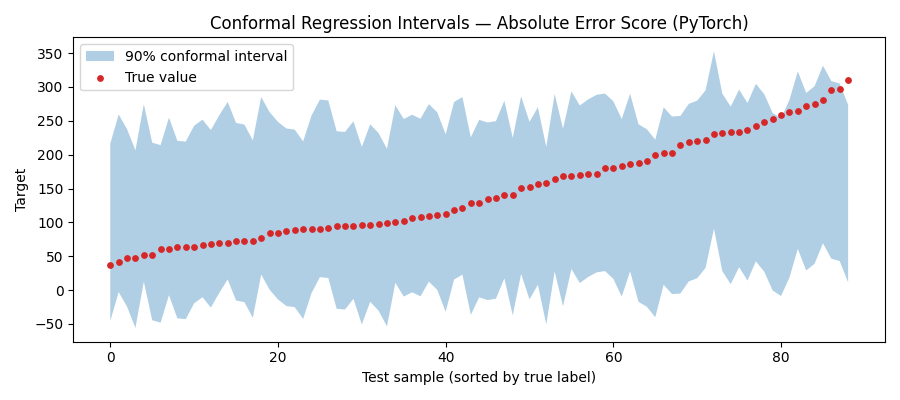
Visualise prediction intervals
intervals = output.tensor.cpu().numpy()  # (n_test, 2)
order = np.argsort(y_test_np)

plt.figure(figsize=(9, 4))
plt.fill_between(
    range(len(y_test_np)),
    intervals[order, 0],
    intervals[order, 1],
    alpha=0.35,
    label="90% conformal interval",
)
plt.scatter(range(len(y_test_np)), y_test_np[order], s=15, color="tab:red", label="True value", zorder=3)
plt.xlabel("Test sample (sorted by true label)")
plt.ylabel("Target")
plt.title("Conformal Regression Intervals — Absolute Error Score (PyTorch)")
plt.legend()
plt.tight_layout()
plt.show()
Summary (Averaged over multiple runs)
res = {"Absolute Error": []}
for fold, (train_idx, test_idx) in enumerate(KFold(n_splits=5, shuffle=True, random_state=42).split(X)):
    torch.manual_seed(fold)
    X_train, y_train = X[train_idx], y[train_idx]
    X_test, y_test = X[test_idx], y[test_idx]
    X_train, X_calib, y_train, y_calib = train_test_split(X_train, y_train, test_size=0.25, random_state=fold)

    X_train_t = torch.tensor(X_train, dtype=torch.float32)
    y_train_t = torch.tensor(y_train, dtype=torch.float32)
    X_calib_t = torch.tensor(X_calib, dtype=torch.float32)
    y_calib_t = torch.tensor(y_calib, dtype=torch.float32)
    X_test_t = torch.tensor(X_test, dtype=torch.float32)
    y_test_t = torch.tensor(y_test, dtype=torch.float32)

    fold_model = SimpleNet(X_train_t.shape[1])
    fold_optimizer = torch.optim.Adam(fold_model.parameters(), lr=0.01)
    fold_model.train()
    for _ in range(300):
        fold_optimizer.zero_grad()
        loss_fn(fold_model(X_train_t), y_train_t).backward()
        fold_optimizer.step()
    fold_model.eval()

    with torch.no_grad():
        calibrated_model = calibrate(conformal_absolute_error(fold_model), 0.05, y_calib_t, X_calib_t)
        output = representer(calibrated_model).predict(X_test_t)

    cov = coverage(output, y_test_t)
    size = efficiency(output)
    res["Absolute Error"].append((cov, size))

for name, vals in res.items():
    covs, sizes = zip(*vals)
    print(f"{name} — coverage: {np.mean(covs):.3f} ± {np.std(covs):.3f}, avg interval size: {np.mean(sizes):.1f} ± {np.std(sizes):.1f}")
Absolute Error — coverage: 0.968 ± 0.017, avg interval size: 263.0 ± 36.9
Total running time of the script: (0 minutes 1.229 seconds)