Note
Go to the end to download the full example code.
DARE on Two Moons
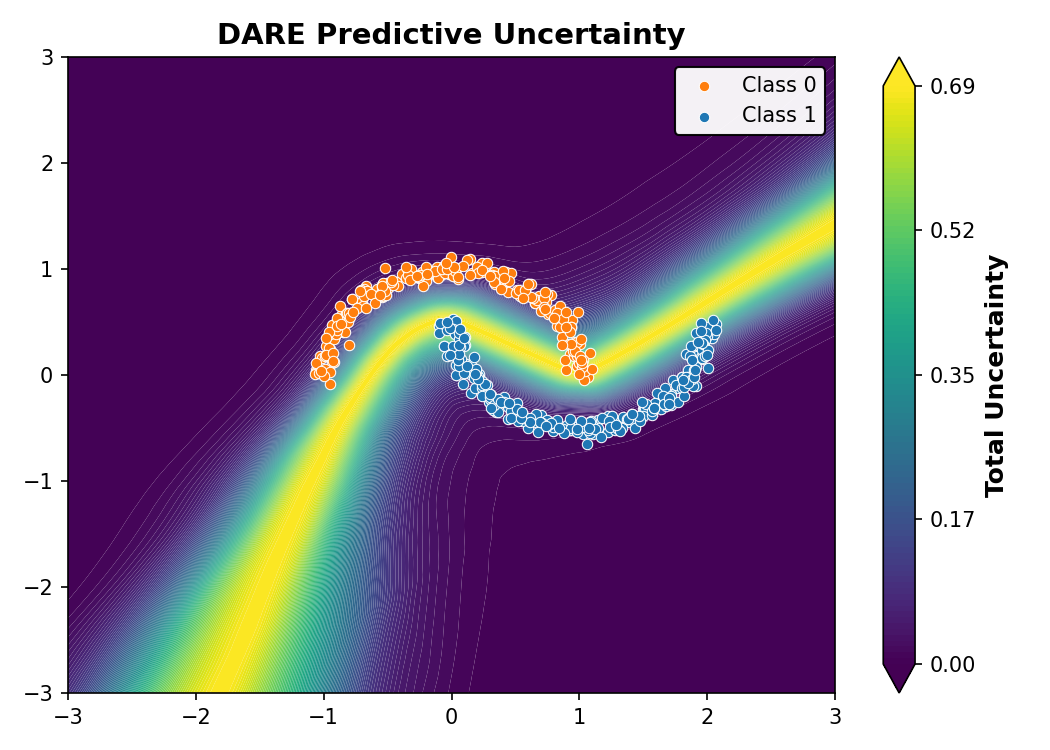
DARE (Deep Anti-Regularized Ensembles) adds a per-member anti-regularization term, active once the task loss drops below a threshold, that pushes each member’s weights to larger magnitudes. Preventing weight collapse preserves the diversity introduced by different initializations, improving ensemble out-of-distribution detection.
from __future__ import annotations

from sklearn.datasets import make_moons
import torch
from torch import nn

from probly.representer import IterableSampler
from probly.method.dare import dare
from probly.train.dare.torch import dare_regularizer

from examples.utils.model import MLPClassifier
from examples.utils.plotting import plot_example_uncertainty
Setup
X, y = make_moons(n_samples=500, noise=0.05, random_state=0)
X_tensor = torch.from_numpy(X).float()
y_tensor = torch.from_numpy(y).long()
Model
DARE wraps an ensemble of independent members. Each member is trained with an anti-regularization term that fires when the per-batch cross-entropy drops below threshold, pushing weights to larger norms and preserving diversity.
base_model = MLPClassifier()

dare_model = dare(
    base_model,
    num_members=3,
    reset_params=True,
    predictor_type="logit_classifier",
)
Training
Train each member with cross-entropy minus the DARE anti-regularization term. The anti-regularizer only activates once the batch loss falls below threshold.
dare_model.train()
threshold = 0.4
for member in dare_model:
    opt = torch.optim.Adam(member.parameters(), lr=1e-3)
    for epoch in range(250):
        opt.zero_grad()
        out = member(X_tensor)
        loss = nn.functional.cross_entropy(out, y_tensor)
        reg = dare_regularizer(member, device="cpu", loss=loss.detach(), threshold=threshold)
        total = loss - reg
        total.backward()
        opt.step()
Uncertainty Evaluation
dare_model.eval()
rep = IterableSampler(dare_model)

plot = plot_example_uncertainty(X, y, rep, title="DARE Predictive Uncertainty", notion="total")
plot.show()
Total running time of the script: (0 minutes 1.244 seconds)