TorchDistanceBasedCredalSet
- class probly.representation.credal_set.torch.TorchDistanceBasedCredalSet(nominal: TorchCategoricalDistribution, radius: Tensor)[source]
Bases:
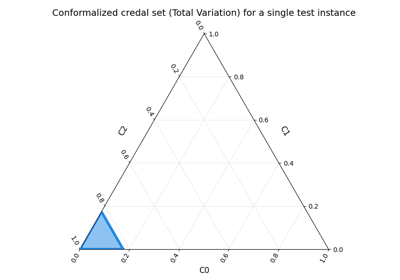
TorchAxisProtected[Any],TorchCategoricalCredalSet,DistanceBasedCredalSetDistance-based credal set around a nominal categorical distribution.
- property barycenter: TorchCategoricalDistribution
Return the nominal distribution as the barycenter of the credal set.
- clone(*, memory_format: memory_format = torch.preserve_format) Self[source]
Return a copy of the array.
- cpu(memory_format: memory_format = torch.preserve_format) Self[source]
Move the array to the CPU.
- cuda(device: device | str | None = None, non_blocking: bool = False, memory_format: memory_format = torch.preserve_format) Self[source]
Move the array to the GPU.
- classmethod from_sample(sample: Sample[TorchCategoricalDistribution]) Self[source]
Create a credal set from a finite sample.
- Parameters:
sample – The sample to create the credal set from.
- Returns:
The created credal set.
- classmethod from_torch_sample(sample: TorchSample[TorchCategoricalDistribution]) Self[source]
Create a credal set from categorical distribution samples.
- gather(dim: int, index: Tensor) Self[source]
Return a copy with gathered protected values along a batch dimension.
- lower() Tensor[source]
Compute the lower envelope of the credal set.
For L1/TV distance, the tightest element-wise lower bound is max(0, nominal - radius).
- nominal: TorchCategoricalDistribution
- permitted_functions = {}
- permute(*dims: Size | int | tuple[int] | list[int]) Self[source]
Return a permuted version of the array.
- protected_values(func: Callable | None = None) dict[str, TorchProtectedValue] | None[source]
Return all protected field values as-is.
Optionally takes the torch function that triggered the call for context. This can be used to conditionally modify the returned values or prevent them from being accessed.
- radius: torch.Tensor
- size(dim: int | None = None) int | Size[source]
Return the size of the array along the given dimension.
- to_device(device: Literal['cpu'], /, *, stream: int | Any | None = None) Self[source]
Move the array to a device.
- type = 'categorical'