Note
Go to the end to download the full example code.
Using the generic predict().
probly defines a small protocol for “predictors” and a generic
probly.predictor.predict() helper.
This can be useful when you want to dispatch behavior based on the predictor type,
while still supporting the simple predictor(x) callable pattern.
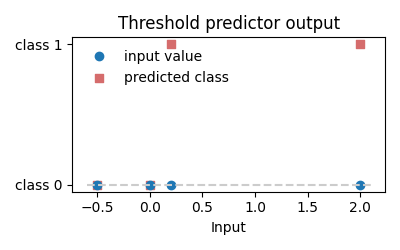
To make the execution visible in the gallery, this example also produces a small plot showing the input values and the predicted class labels.
from __future__ import annotations

from dataclasses import dataclass

import matplotlib.pyplot as plt
import numpy as np

from probly.predictor import predict


@dataclass(frozen=True)
class ThresholdPredictor:
    """Threshold-based predictor for the gallery demo."""

    threshold: float = 0.0

    def __call__(self, x: np.ndarray) -> np.ndarray:
        """Return binary predictions using the configured threshold."""
        return (x > self.threshold).astype(int)


x = np.array([-0.5, 0.0, 0.2, 2.0])
preds = predict(ThresholdPredictor(threshold=0.1), x)

plt.figure(figsize=(4, 2.5))
plt.plot(x, np.zeros_like(x), "o", label="input value")
plt.hlines(0, x.min() - 0.1, x.max() + 0.1, colors="#cccccc", linestyles="--")
plt.scatter(x, preds, color="#d56c6c", marker="s", label="predicted class")
plt.xlabel("Input")
plt.yticks([0, 1], ["class 0", "class 1"])
plt.title("Threshold predictor output")
plt.legend(loc="upper left", frameon=False)
plt.tight_layout()
Total running time of the script: (0 minutes 0.056 seconds)